
Ways to Stay Active During the Long Winter Months

Updated: Jan 2
Cogent Rehab Blog
Folarin Babatunde PT PhD MScSEM MScPT BScPT
December 22, 2025
A Physiotherapist’s Guide for Adults and Seniors

Why Winter Makes Staying Active Harder for Many People
For many Canadians, winter brings an ongoing cycle of heavy snowfall, icy sidewalks, early darkness, and packed schedules. These factors make it harder to walk outdoors, attend regular exercise classes, or keep consistent routines. As a result, people often sit more without realizing it.
This matters because sedentary behaviour—long periods of sitting or lying down while awake—is now recognized as an independent health risk, even in people who exercise occasionally.
Winter and Sedentary Behaviour: What the Evidence Shows
Research using activity monitors shows a clear seasonal pattern:
People tend to sit more in winter than in spring or summer.
Canadian adults average about 9.3 hours per day of sedentary time, and fewer than half meet recommended limits.
In older adults, winter often leads to fewer daily steps, even when total sitting time appears unchanged—meaning less overall movement during the day.
Bottom line: Winter doesn’t just reduce exercise—it quietly increases prolonged sitting. That’s why the Canadian 24-Hour Movement Guidelines emphasize breaking up sedentary time, not just “working out.”
What the Canadian 24-Hour Movement Guidelines Recommend
The Guidelines look at the entire day, not just exercise.
Adults (18–64 years)
≥150 minutes/week of moderate-to-vigorous aerobic activity
Strength training at least 2 days/week
Limit sedentary time and break up long sitting periods
7–9 hours of sleep per night, with consistent routines
Older Adults (65+ years)
≥150 minutes/week of aerobic activity (as tolerated)
Strength training at least 2 days/week
Balance-challenging activities to reduce fall risk
Limit sedentary time and maintain regular sleep
Winter often challenges the sedentary time and balance parts of these guidelines the most.
Using FITT Principles to Stay Active All Winter

FITT helps turn guidelines into a realistic plan:
Frequency – how often
Intensity – how hard
Time – how long
Type – what you do
1) Aerobic Activity (Winter-Friendly Cardio)

FITT Prescription – Adults (18–64)
Frequency: 4–6 days/week
Intensity: Moderate (5–6/10 effort; you can talk but not sing)
Time: 20–40 minutes/session (or 2 × 10–15 minutes/day)
Type: Indoor walking, treadmill, stationary bike, stairs (if safe), mall walking
Progression: Add 5 minutes every 1–2 weeks until you reach 150 minutes/week.
FITT Prescription – Seniors (65+)
Frequency: 4–6 days/week
Intensity: Moderate (4–6/10 effort)
Time: 15–30 minutes/session (or 3 × 10 minutes/day)
Type: Indoor walking, recumbent bike, mall walking, pool walking
Focus: Consistency and confidence, not speed.
Struggling with pain, stiffness, or balance during the winter months? Our physiotherapists can help you stay active safely with a plan tailored to your needs and the Canadian 24-Hour Movement Guidelines.
2) Strength Training (Essential for Winter Resilience)
Strength training supports joints, posture, balance, and independence—and is recommended for all adults.
FITT Prescription (Adults & Seniors)
Frequency: 2–3 days/week (non-consecutive)
Intensity: Last 2–3 reps feel challenging but controlled
Time: 20–30 minutes (adults) | 15–25 minutes (seniors)
Type: Bodyweight or light resistance exercises
Winter-Ready Strength Circuit
Sit-to-Stand (Chair Squats)
2–3 sets of 8–12 reps
Cue: lean forward slightly, stand using legs, sit slowly

Wall Push-Ups
2–3 sets of 8–15 reps

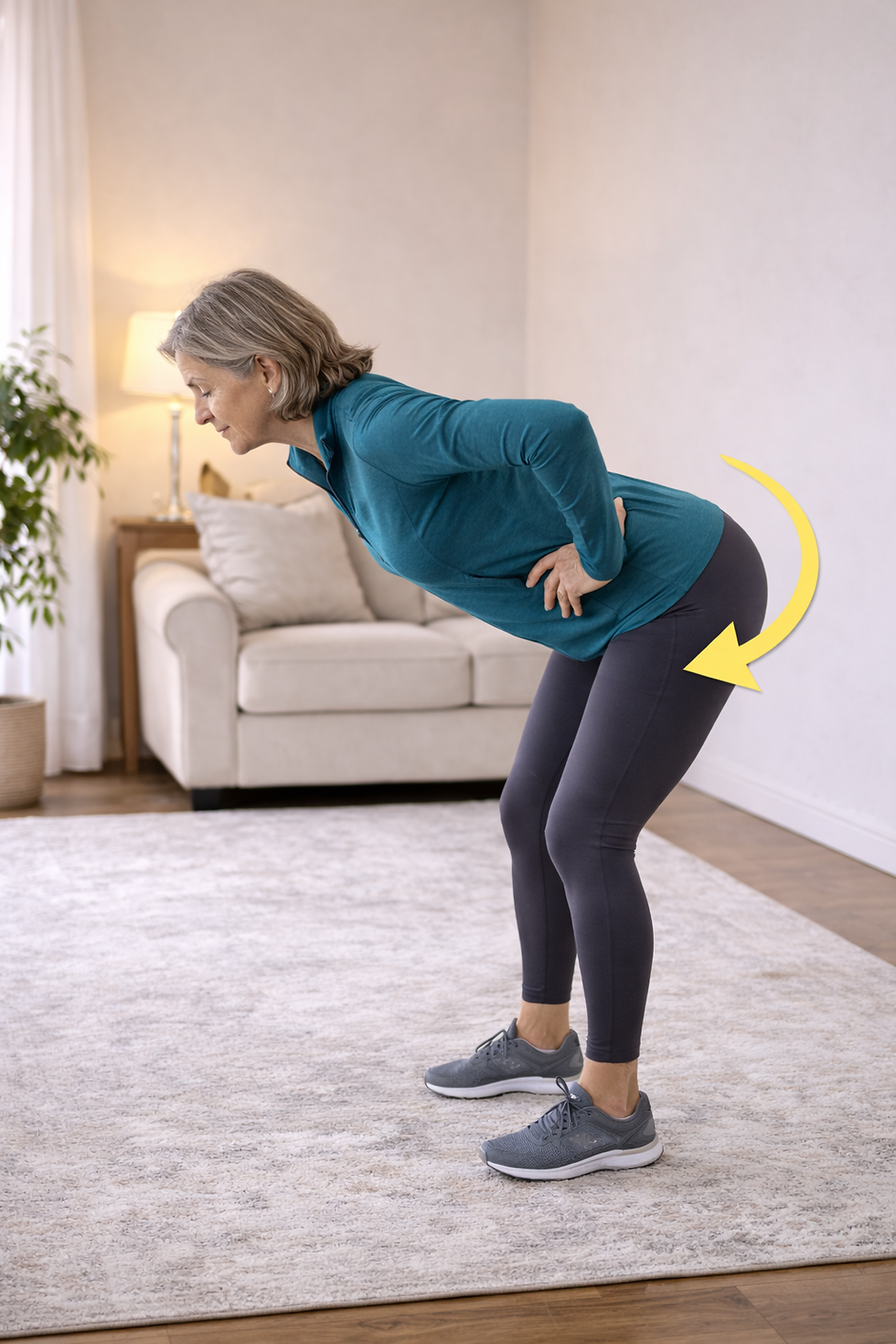
Hip Hinge (Good-Morning Pattern)
2–3 sets of 8–12 reps
Cue: push hips back, keep spine long
Step-Ups (Bottom Stair)
2–3 sets of 6–10 reps per side
Use railing if needed

Calf Raises
2–3 sets of 10–15 reps

3) Balance Training (Especially Important for Seniors)
Balance work helps reduce fall risk and maintain confidence during icy months.
FITT Prescription – Seniors
Frequency: 3–7 days/week
Intensity: Challenging but safe
Time: 3–8 minutes/session
Type: Simple balance drills near a counter
Balance Exercises
Single-Leg Stance: 3 × 10–30 seconds per leg

Tandem Stance (Heel-to-Toe): 3 × 20–30 seconds

Side Steps: 2 × 10 steps each direction

4) Break Up Sitting Time (The Missing Winter Habit)
Even if you exercise, long sitting periods matter.
FITT Mini-Prescription – Sedentary Breaks
Frequency: Every 45–60 minutes
Intensity: Light
Time: 2–3 minutes
Type:
Walk around the room
10 sit-to-stands
March in place
Gentle stair climbing
Daily target: Accumulate 20–30 minutes of light movement through breaks.
5) Sleep: The Third Pillar of Winter Health
Sleep supports immunity, mood, and recovery—and winter routines often drift.
Aim for 7–9 hours/night
Keep consistent bed and wake times
Dim lights in the evening and reduce screen use

How Physiotherapy Can Help During Winter
Physiotherapy can help if winter leads to pain, stiffness, dizziness, or fear of falling by:
Identifying safe indoor activity options
Building a winter-specific strength and balance plan
Managing flare-ups before they stop your routine
Improving confidence with movement on icy days
Takeaway
Winter doesn’t have to mean inactivity. Using the Canadian 24-Hour Movement Guidelines and simple FITT principles, adults and seniors can stay active, reduce sitting time, and protect their strength, balance, and independence all winter long.
Need help staying active this winter without flare-ups or falls?
Book a physiotherapy assessment at Cogent Rehab Burlington to create a personalized winter movement plan that improves strength, balance, and confidence—indoors and outdoors.
Sources
Canadian Society for Exercise Physiology. (2020a). Canadian 24-hour movement guidelines for adults aged 18–64 years: An integration of physical activity, sedentary behaviour, and sleep. https://csepguidelines.ca/guidelines/adults-18-64/
Canadian Society for Exercise Physiology. (2020b). Canadian 24-hour movement guidelines for adults aged 65 years or older: An integration of physical activity, sedentary behaviour, and sleep. https://csepguidelines.ca/guidelines/adults-65/
Ross, R., Chaput, J.-P., Giangregorio, L. M., Janssen, I., Saunders, T. J., Kho, M. E., … Tremblay, M. S. (2020). Canadian 24-hour movement guidelines for adults aged 18–64 years and adults aged 65 years or older: An integration of physical activity, sedentary behaviour, and sleep. Applied Physiology, Nutrition, and Metabolism, 45(10), S57–S102.
ParticipACTION. (2020). Canadian 24-hour movement guidelines for adults aged 18–64 years [Guideline summary]. https://participaction.com/resources/canadian-24-hour-movement-guidelines-for-adults-18-64/
ParticipACTION. (2020). Canadian 24-hour movement guidelines for adults aged 65 years and older [Guideline summary]. https://participaction.com/resources/canadian-24-hour-movement-guidelines-for-adults-65/
Statistics Canada. (2025). Directly measured physical activity and sedentary time in Canada, 2022 to 2024. The Daily. https://www150.statcan.gc.ca/n1/daily-quotidien/251017/dq251017a-eng.htm
Statistics Canada. (2022). Health associations with meeting the Canadian 24-hour movement guidelines among adults. Health Reports, 33(11), 3–13.
Turrisi, T. B., Bittel, K. M., West, A. B., Hojjatinia, S., Mama, S. K., Lagoa, C. M., & Conroy, D. E. (2021). Seasons, weather, and device-measured movement behaviors: A scoping review from 2006 to 2020. International Journal of Behavioral Nutrition and Physical Activity, 18(1), Article 24.
Government of Canada. (2025). How close people in Canada are to meeting physical activity recommendations. Health Infobase. https://health-infobase.canada.ca/datalab/physical-activity-blog.html

Comments