
Core Anatomy 101: Understanding The Muscles That Support Your Spine

Cogent Rehab Blog
Folarin Babatunde PT PhD MScSEM MScPT BScPT
January 23, 2026
When most people hear the term core strength, they immediately think of sit-ups or “six-pack” muscles. In reality, your core is 3D complex, coordinated system designed to support your spine, control movement, and transfer force between your upper and lower body. Whether you are walking, lifting, running, reaching overhead, or simply maintaining posture at a desk, the core’s role is less about bending and more about controlling motion, transferring force, and protecting the spine under load.
Understanding how the core is structured—and what it actually does—can change how you approach exercise, injury prevention, and recovery from back pain. This article focuses on the anatomy, structure, and function of the core—so you can understand what you are training and why “core stability” is such more than doing crunches.
What Is the Core?
The core is best understood as a pressure-and-support system, often described as a canister or cylinder:
At the Top is the diaphragm
At the Bottom is the pelvic floor
At the Front and sides are the superficial and deep muscles of the abdominal wall
Located at the Back are the deep spinal stabilizers and thoracolumbar fascia
Key partners include the glutes, hip rotators, and lats because the trunk and pelvis both work as a unit.
Rather than relying on one “magic muscle,” core stability emerges from coordination across all of these structures.This explains why effective physiotherapy and therapeutic exercise programs focus on control, endurance, and integration, not just isolated strength.
The Core’s Three Primary Jobs
1) Create stability (without stiffness you can’t turn off)
Core stability means the trunk can be controlled when forces such as gravity, impact, carrying a load, or limb movement act on it. A stable trunk is not a rigid trunk. The goal of core stability training is achieve appropriate stiffness at the right time, then relaxation when the job is done.

2) Transfer force between upper and lower body
Most real-world movement is “linked.” For example, when your legs generate force when going up stairs, doing squats or running, the trunk must transfer that force upward. Also, when your arms generate force during lifting, pushing, pulling, the trunk must transfer it downward into the pelvis and legs.
3) Control pressure (especially during lifting and exertion)
Breathing, bracing, and pelvic floor function influence intra-abdominal pressure, which can support the spine during exertion. This is one reason coaching often includes breathing cues during core rehab and strength training.
The Layers of Core Muscle Anatomy
The Abdominal Wall (Front and Sides): More Than Just Abs
Transversus Abdominis (TrA) - The Deep Stabilizer
The transversus abdominis is the deepest abdominal muscle. It fibers run horizontally, wrapping around the trunk like a corset.
Primary Role:
Increases intra-abdominal pressure control
Provides segmental spinal support
Prepares the trunk for movement of the arms and legs.
Works with breathing and pelvic floor coordination
Key point:
The TrA does not produce large visible movements. Instead, it works quietly in the background to stabilize the spine during everyday tasks such as walking, lifting, and reaching.
It’s a stability and control muscle, often trained early in physiotherapy and rehab to help with restoring timing and endurance to your core.

Internal and External Obliques - Control and Rotation
The internal and external oblique muscles sit above the TrA and run diagonally across the abdomen.
Primary Role:
Help control trunk rotation and side bending
Assisting with load and force transfer between the rib and pelvis
Supporting posture during asymmetric activities
Key point:
Obliques are major players in “anti-rotation” and side-stability work (e.g., side plank variations).
These muscles become especially important during sports, carrying uneven loads, or movements that involve twisting.

Rectus Abdominis - The Global Mover
The rectus abdominis is the most superficial abdominal muscle and its fibers run vertically from ribcage to pelvis and forms the typical “six-pack.” .
Primary Role:
Produces trunk flexion (like a crunch)
Assists in controlling rib position relative to pelvis
Key point:
While it contributes to movement, it is not a primary stabilizer of the spine on its own. A strong rectus does not guarantee good trunk control under load.
Overemphasizing rectus-dominant exercises without addressing deeper support can actually worsen back symptoms in some individuals.

The Deep Back Stabilizers (Posterior Core)
Multifidus - Segmental Stability
The multifidus muscles are small, deep muscles that span and connect individual vertebrae.
Primary Role:
Helps manage small, unwanted spinal movements during limb motion
Fine control and stabilization of each spinal segment
Key point:
Research consistently shows that multifidus function is often reduced in people with persistent or recurrent low back pain, highlighting the importance of retraining—not just strengthening—them.
Small stabilizers of the spine can become inhibited when the system is painful or guarded.

Erector Spinae - Posture and Extension
The erector spinae muscle group consists of three larger muscles running along the spine.
Iliocostalis (lateral)
Longissimus (Intermediate)
Spinalis (medial)
Primary Role:
Contributes to straighthening the back and gending backwards
Provide “global” support during sustained postures (sitting, standing)
Control the speed and control of bending forward
Assist with side bending
Key point:
These muscles are essential, but when they overwork to compensate for poor coordination elsewhere, people often feel “tight low backs.”
These muscles are powerful but work best when supported by the deeper stabilizing system.

The Diaphragm - The Roof
The diaphragm is a dome-shaped breathing muscle that separates chest and abdomen and essential for core stability.
Primary Role:
Primary muscle of respiration
Works with abdominal wall and pelvic floor to regulate intra-abdominal pressure
Contributes to trunk stability, especially during exertion
Key point:
If breathing is shallow or bracing is excessive, the core system can become less efficient—strong, but not well-coordinated.
Pelvic Floor - The Base
The pelvic floor muscles form a supportive sling at the bottom of the pelvis. Dysfunction at the pelvic floor can compromise the entire core system.
Primary Role:
Assists with continence and pressure regulation during movement.
Supports lumbopelvic stability alongside the diaphragm and deep abdominals
Key point:
Pelvic floor is part of core function for everyone (not only postpartum clients).
Good core training respects breathing and pressure mechanics instead of constant maximal bracing.

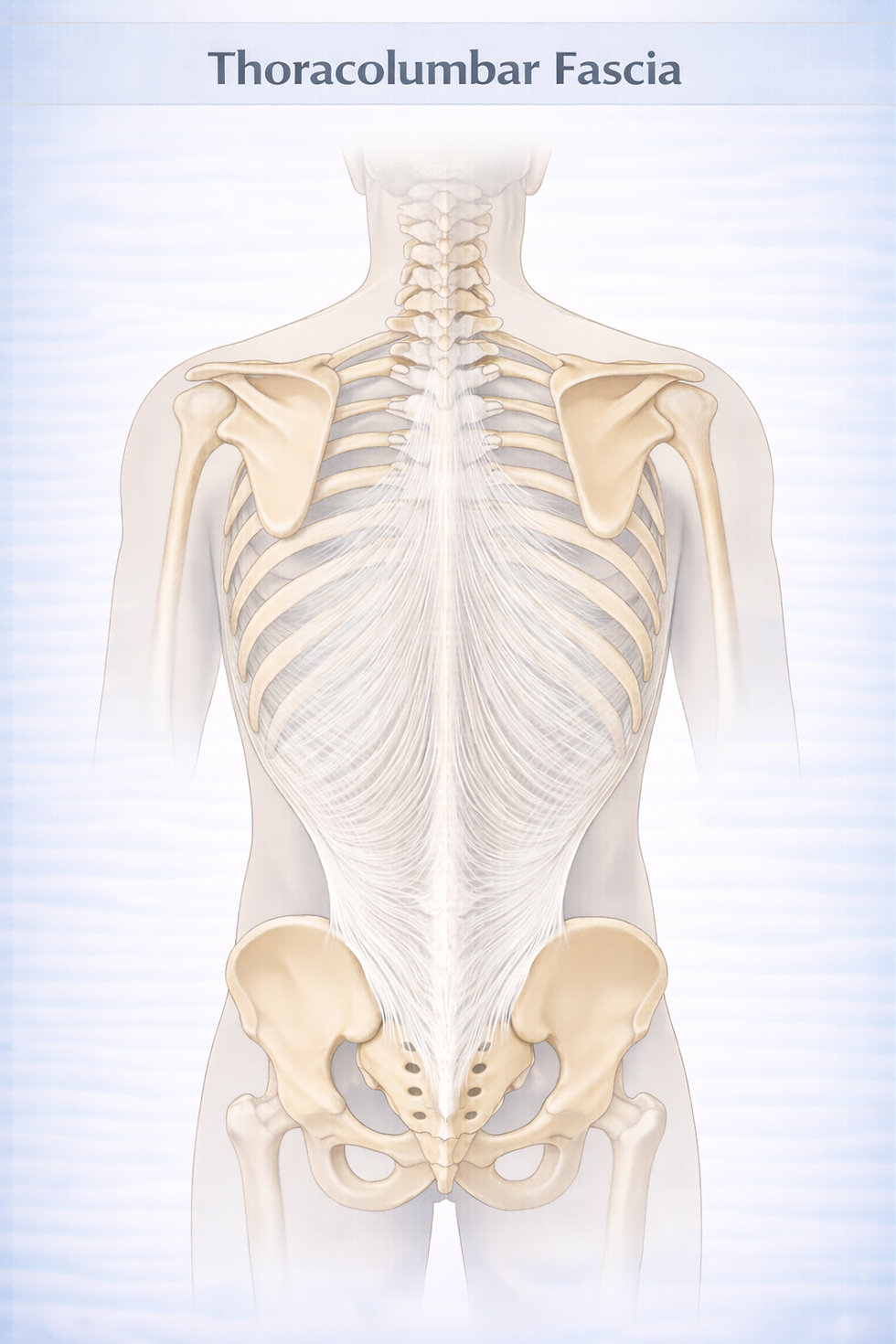
Thoracolumbar Fascia - The Force-Transfer Network
The thoracolumbar fascia (TLF) is a thick, multilayered connective tissue structure in the lower and mid-back. It connects the spine to the pelvis, ribs, abdominal wall, gluteal muscles, and latissimus dorsi.
Primary Role:
Rather than contracting like a muscle, the TLF:
Transmits forces between the upper and lower body
Contributes to spinal stiffness and stability
Plays a key role in efficient movement and load transfer
Key point:
When core coordination is poor, load is no longer shared effectively across this system—often increasing stress on the lumbar spine.
This is one reason “core” training often includes integrated patterns—not just isolated ab work.
Core Stability vs Core Strength: A Practical Distinction
Core strength often describes how much force a muscle can produce.
Core stability describes how well the system controls motion and transfers force.
True core stability is about the ability to:
Maintain spinal control during movement
Transfer force efficiently between limbs
Sustain posture and movement over time
A simple clinical example:
You can have strong abs (high strength) but still lose pelvic control during single-leg stance (poor stability).
You can have decent stability at low load but struggle when the task adds speed, fatigue, or external load.
This is why effective programs often progress from:
Low-load control targeting alignment, breathing, timing; to
Endurance and anti-movement tasks in anti-extension/anti-rotation; to
Standing, stepping, and carrying targeting force transfer in real life
Common Misconceptions About Core Muscles
Misconception 1: “Core = abs”
Reality: Core includes breathing (diaphragm), pelvic floor, deep trunk stabilizers, abdominal wall, and the back, working together.
Misconception 2: “If my back is sore, my core is weak”
Reality: Soreness can reflect overwork, poor coordination, fatigue, or load intolerance, not simply weakness.
Misconception 3: “A stronger core means bracing hard all the time”
Reality: Core control is the ability to turn stability on and off. Over-bracing can increase fatigue and reduce movement efficiency.
A Quick Self-Check: What Core Function Looks Like in Daily Movement
A well-functioning core typically shows up as:
Steady breathing under light effort
Controlled rib and pelvis position during walking and navigating stairs
Ability to carry or lift without excessive trunk sway
Improved endurance (less “posture collapse” late in the day)
Smoother transitions during sit-to-stand, turning, reaching
How Physiotherapy Helps Restore Core Function
A physiotherapy assessment at Cogent Rehab looks beyond surface strength to evaluate:
Your breathing mechanics
How well you can activate deep muscles of the spine
Your spinal movement coordination
Your spinal endurance and load tolerance
Treatment may include targeted exercises, movement retraining, and education tailored to your daily activities, work demands, or sport.
Key Takeaways
The core is not a single muscle—it is a system. This summary of core muscle anatomy shows it's main role is stability, pressure control, and force transfer, not just sit-ups. Improving core function means improving how the diaphragm, abdominal wall, spinal stabilizers, fascia, and pelvic floor work together.
Understanding this anatomy is the first step toward safer training, better performance, and more resilient movement. This also shows why effective therapeutic exercise progressions need to be function-driven going from control to endurance to integration.
Ready to Apply This Knowledge to Your Own Movement?
Understanding core anatomy is the first step. Applying it correctly—based on how your body moves, breathes, and handles load—is where real change happens.
At Cogent Physical Rehabilitation Center, our physiotherapists assess:
how your core muscles coordinates spine movement,
how breathing and posture influence spinal stability, and
which exercises will actually support your goals—whether that’s reducing back pain, improving performance, or moving with more confidence.
If you’re dealing with recurring back pain, stiffness, or uncertainty about how to train your core safely, a physiotherapy assessment can help clarify what your core needs.
Sources
Dalley, A. F., & Agur, A. M. R. (2023). Moore's Clinically Oriented Anatomy (9th ed.). Wolters Kluwer.
Luo S, Soh KG, Soh KL, Sun H, Nasiruddin NJM, Du C, Zhai X. Effect of core training on skill performance among athletes: a systematic reviw. Front Physiol. 2022;13:915259
Oliva-Lozano J, Muyor JM. Core muscle activity during physical fitness exercises: a systematic review. Int J Environ Res Public Health. 2020;17:4306.
Smrcina Z, Woelfel S. Burcal C. A systematic review of the effectiveness of cire stability exercises in patients with non-specifiu low back pain. Int J Sports Phys Ther. 2022;17:766-774.
Beattie PF, Bishop MD, Goertz C, Hunter S, Olson KA, Rundell SD, Schmidt M, Shepard M, Vining R. . Interventions for the management of acute and chronic low back pain: Revision 2021. Journal of Orthopaedic & Sports Physical Therapy, 2021;51:CPG1–CPG60.


Comments